Despite numerous efforts to reduce workplace injuries, particularly ones with fatal consequences, a critical factor often overlooked is the subjective nature of risk perception. In daily operations, safety and organizational leaders often assume others share their reality about risk, which is far from the truth. Risk is a subjective construct shaped by our individual experiences, context, and motivations (personal and organizational). This disparity highlights the reality and gap between how work is designed and how it is actually done by employees on the ground.
The classic 1954 study by Hastorf et al. refered to as “They Saw a Game” demonstates the power of perceptual bias. In the study, after a contentious American football game between rivals Princeton and Dartmouth with several penalties on both sides, and unhappy students, researchers asked students to watch the same film and record the violations as they saw it. Despite watching the same film, the result demonstrated the power of our preexisting bias on our perception. Dartmouth students saw their team as less aggressive and Princeston students saw Dartmouth team as excessively violent. This phenomenon of perception directly applies to workers’ perception of risk
According to the researchers,
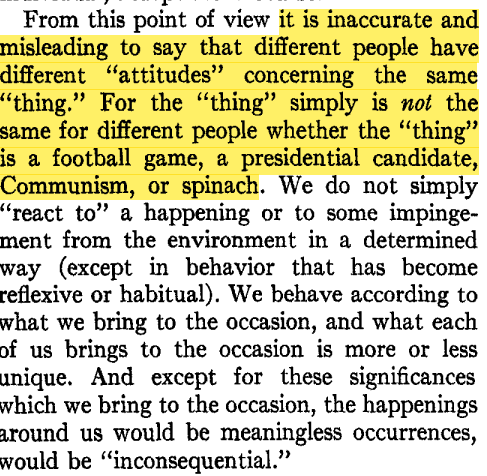
Risk isn’t a universally defined static entity. It’s heavily influenced by individual circumstances, experiences, and contexts. It is therefore inaccurate to say that different people have different “attitudes or behavior” towards risk, for risk, simply is not the same for everyone. According to Roberts (2023), it is mostly our perception of risk that influences our decision-making. From this viewpoint, it can be argued that a worker’s perception of their reality directly impacts their behavior, regardless of existing safeguards. Could this partly explain why, despite robust safety policies and procedures, many industries continue to grapple with high rates of workplace injuries?
A cognitive bias worth noting that exacerbates this issue is what psychologists call confirmation bias. Confirmation bias essentially is believing that things are what we expect them to be; it’s interpreting reality to fit our existing mental models, leading us to overlook or downplay potential hazards. This condition and disconnect between our perception of risk to our reality highlights the crucial need to address the human element in safety management.
As the late James Reason famously stated in his influential work on human error, we cannot change the human condition, but we can change the conditions under which humans work. In other words, instead of focusing on changing human behavior towards risk, we should focus on changing the environment and providing individuals with the capacity to accurately perceive, communicate, and manage risk within their unique context. One of such capacities which has an immerse influence on perceptional behavior, performance, and learning is the creation and management of a psychologically safe environment built on mutual trust.
In an environment where workers trust their opinions matter, they feel comfortable to openly discussing risk (from their perspective), before work and especially when faced with surprises or anomalies during normal work. This open dialogue about risk fosters a deeper understanding of individual perceptions and allows for a collective and proactive management of potential hazards. When employees can share their perspectives and ideas about risk and work freely and openly, the organization gains a deeper understanding of the workers, their perspectives, and how work is actually done.
In conclusion, by prioritizing psychological safety and trust, organizations can create a more resilient and adaptable learning environment, one that is equipped to manage the inherent challenges of human fallibility. The more people feel comfortable sharing their perspectives, ideas, admitting mistakes, and speaking to potential problems, the more we can learn, and adapt. Just as Rome wasn’t built in a day, it is important to understand this kind of culture is an ongoing process that requires leadership that has a genuine commitment to valuing diverse perspectives.
Sources
Hastorf, A. H., Cantril, H., & Hunt, J. M. (1954). They saw a game; a case study. Journal of Abnormal and Social Psychology, 49(1), 129–134. https://doi.org/10.1037/h0057880
Reason, J. (2000). Human error: models and management. BMJ, 320(7237), 768–770. https://doi.org/10.1136/bmj.320.7237.768
Roberts, A. (2023) Communicating risk through storytelling. AIHA. https://www.aiha.org/blog/communicating-risk-through-storytelling