On my flight to Santa Fe for a Learning Lab, I was listening to Daniel Pink’s book A Whole New Mind. In Chapter 9, Meaning, he makes a distinction between a maze and a labyrinth. until that moment, I had never heard about labyrinths, so the idea kept me in inquiry mode for the entire flight. I do not believe in coincidence, but what transpired next felt profound.
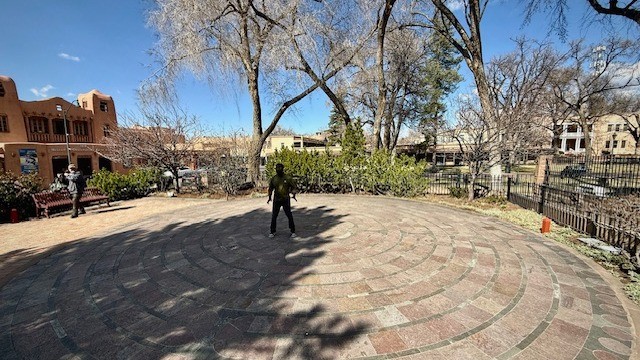
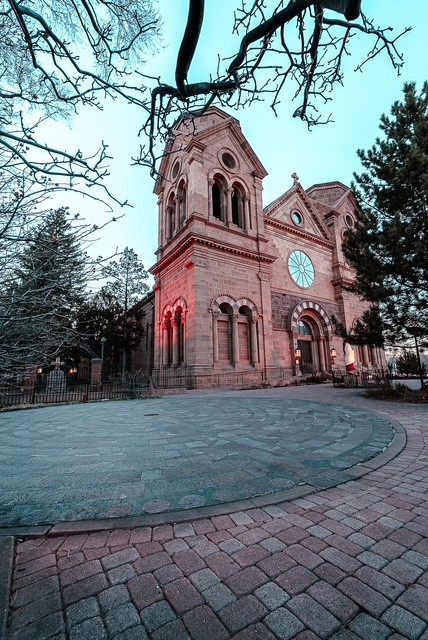
The next day, during a risk walk through the beautiful and historic town of Santa Fe with other participants, we stopped at the Cathedral Basilica of Saint Francis of Assisi. And there it was; a labyrinth. Here I was, the previous day hearing about labyrinths for the first time, and here it was, unplanned and unexpected. One of those moments that gives you goosebumps and feels like it was meant to be.
The following morning, during an early morning run and to capture some of the beautiful scenery and architecture of Sant Fe. And yes, I am one of those people who always has a camera with me in a new city. Curiosity pulled me back to the church. I decided to walk the labyrinth for the first time that quite morning. I chose a grounding word and slowly made my way along the path, reflecting as I walked. What struck me was the circular form of a shape often associated with wholeness and the feeling of seeing connections rather than fragments.
Now, to be clear, I am not trying to make safety spiritual. But sometimes experiences outside of work provide metaphors that help us better understand what happens inside organizations.
As I moved through the turns of the labyrinth, I kept thinking about a learning review exercise we had done the previous day. Using mind-mapping and sticky notes, we explored how events are shaped by multiple interacting factors, not a single linear cause. This aligns with Ivan Pupulidy, PhD and Crista Vesel, MScidea of networks of influence which encourages divergent thinking and acknowledges many possible opportunities to innovate around problems, instead of following a linear path. Walking the labyrinth made that idea very tangible. It brought me back to Daniel Pink’s distinction. A maze is a puzzle with many paths, dead ends, and one correct solution. A labyrinth is different; it has a single path that twists and turns in a spherical manner allowing you to see and have a holistic view of the path. Sometimes moving away from the center before bringing you back. Unlike a maze, it is not meant to be solved; it is meant to be walked.
That distinction captures something important about how many organizations think about safety. Much of traditional safety treats work like a maze;predictable, linear, cause/effect, and solvable. If we identify hazards, write procedures, and enforce compliance, then workers simply need to follow the correct path. In that view, incidents happen because someone took the wrong turn. But real work rarely behaves like a maze. Conditions change, equipment behaves differently than expected, production pressure shifts priorities, and information is often incomplete at the moment.
For example, imagine a worker bypassing a lockout procedure to clear a jam. The investigation would often stops at “The procedure was not followed.” In the context of maze, the wrong turn was taken; case closed. But what often goes unexplored is the path the worker was navigating in the moment. Was the conveyor jamming repeatedly? Was there pressure to keep production running? Had this become normalized over time? Was the procedure practical in that situation? These are questions left often unexplored when we treat work as a maze, focusing on the missed rules.
Now imagine we treat understanding events like a labyrinth, a holistic, nonlinear way of looking at work. This approach affords us the opportunity to understand why things made sense for people in the moment. Rather than solving the issue, this way of thinking allows us to try to understand the conditions shaping decisions. We get to see and understand all the influences that shape an action. Because let’s be honest, in real work (work-as-done), the path unfolds as people move through it. It is not linear or structured as the work-as-design makes us think. Workers are constantly making sense of situations in real time. Sensemaking is how people interpret what’s happening around them and decide what to do in the moment, based on what makes sense to them. What is going on right now? What does this mean? What should we do next?
So instead of asking:why didn’t an employee follow a path (maze), we ask what did the path look like from where they were standing (labyrinth). That question opens the door to understanding how the system actually operates. And that understanding is where learning begins.
As I walked through the labyrinth that morning, I felt a shift away from trying to find the right answers to questions about my life, and toward simply understanding my path. It created a space for me to see things more holistically, not as a straight line. As a set of connected influences unfolding over time.
It made me wonder what might we learn about our work, our people, and our organizations if we approached events like a labyrinth to be understood, rather than a maze to be solved. Because real work does not unfold in straight lines. Just like the labyrinth, it twists, turns, and only reveals itself as we move through it. To truly learn, we must walk events from the perspective of the worker; considering the many influences shaping their actions in the moment. That is what the labyrinth reminded me. Not to rush to a conclusion, but to understand the path.
So, I am left wondering: What might change in our organizations if we stopped searching for the wrong turn, and started trying to understand the path? What might we learn if we walked the event the way the worker experienced it?